
G U T H E A L T H The science behind a healthier gut Your digestive tract hosts trillions of microorganisms that shape how you break down food, how your immune system responds, and even how you feel. Probiotics are the live, beneficial bacteria that help keep that community in balance. Here is what the science supports, what it does not yet support, and how to read a label so you get what you paid for. |
Published by ProbioFerm • Urbandale, Iowa • Reviewed by our fermentation and R&D team
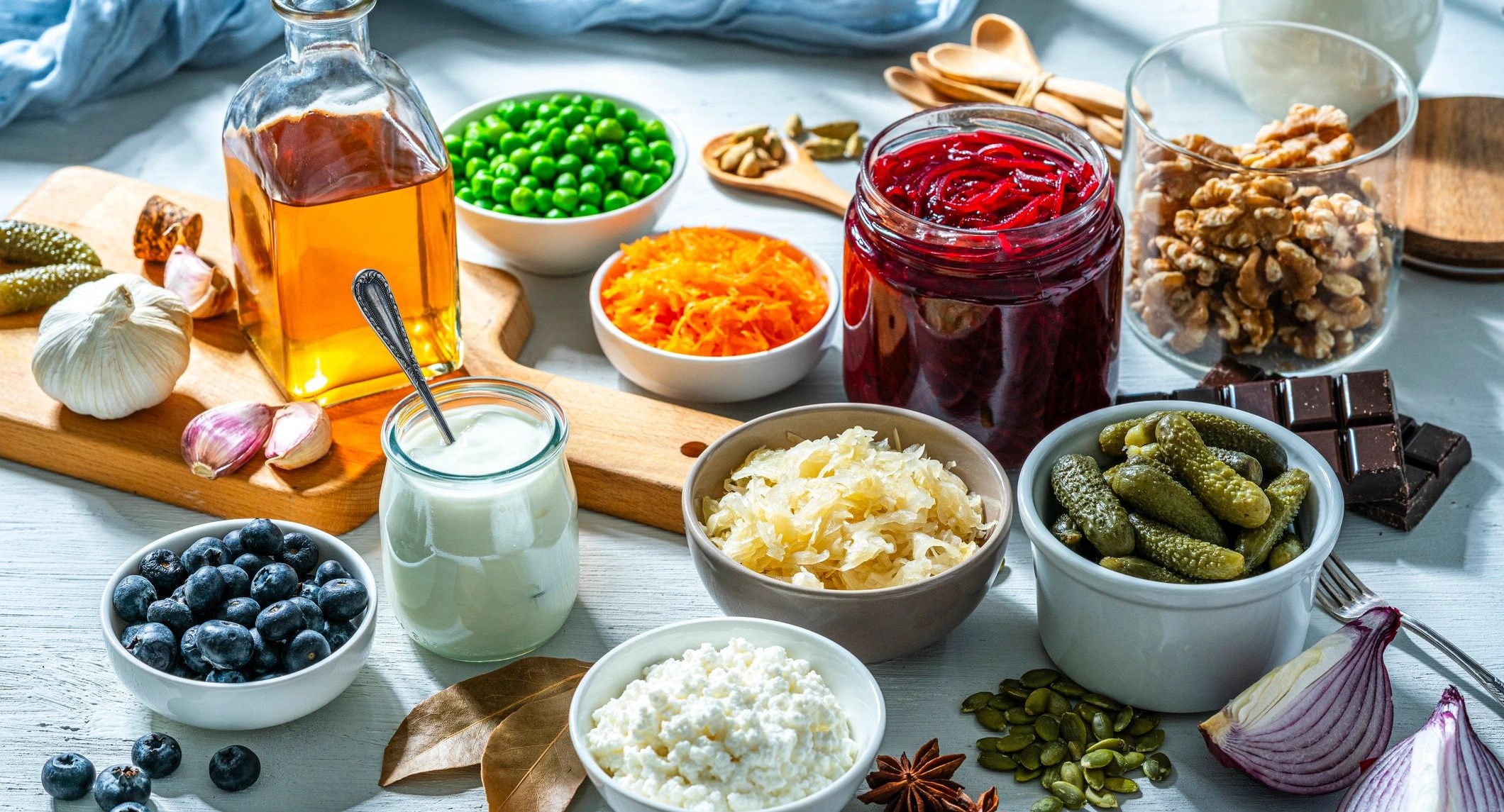
Fermented foods — yogurt, kefir, sauerkraut, kimchi, and miso — remain the most accessible dietary sources of live cultures.
Your gut is an ecosystem, not a pipeline
Your digestive tract is home to roughly 100 trillion microorganisms that break down food, synthesize vitamins, and communicate continuously with your immune and nervous systems. Often called the “second brain,” the gut microbiome influences digestion, immune resilience, and mental clarity.
Modern life puts real pressure on that balance. Chronic stress, heavily processed diets, and courses of antibiotics all reduce microbial diversity — and that shows up as bloating, irregularity, fatigue, and more frequent illness. Probiotics work by replenishing beneficial bacteria, supporting digestion, and reinforcing the intestinal barrier that keeps unwanted material out of circulation.
What counts as a probiotic The term has a specific definition: live microorganisms that, when administered in adequate amounts, confer a health benefit on the host (FAO/WHO). Three conditions must hold — the organisms must be alive, present in sufficient numbers, and studied at the strain level. A product that misses any one of those is not delivering what the category promises. |
What probiotics actually do
Probiotics are living organisms, not a compound or a nutrient. They have to survive manufacturing, storage, and stomach acid before they can do anything at all. When they arrive intact and in sufficient numbers, this is where the evidence is strongest — and where it is still developing.
1. Digestive comfort and efficiency
A balanced microbiome helps break down food and absorb nutrients. Strains from the Lactobacillus group — reclassified in 2020 into genera including Lacticaseibacillus and Lactiplantibacillus — and from Bifidobacterium are the most extensively studied for easing occasional gas, bloating, and irregularity.
2. Immune support
Roughly 70% of the body’s immune cells reside in gut-associated lymphoid tissue, the immune network embedded in the intestinal lining. A well-populated, intact gut barrier limits how much unwanted material reaches that tissue in the first place — which is why gut integrity and immune function are so closely linked.
3. The gut–brain connection
Gut bacteria produce and modulate neurotransmitter precursors, including those in the serotonin pathway, and the large majority of the body’s serotonin is made in the gut rather than the brain. The research on mood and cognition is genuinely promising, but it is early. Treat it as a reason to watch the field, not as a reason to expect a specific outcome.
4. Inflammatory balance
Certain strains help modulate the body’s normal inflammatory response, which supports joint comfort and general resilience over time.
5. Recovery after antibiotics
Antibiotics do not distinguish between harmful and beneficial bacteria. Taking probiotics during and after a course helps repopulate what was lost. One practical note: space your probiotic at least two hours from the antibiotic dose, or you are simply feeding the antibiotic.
6. Vitamin synthesis
Some strains produce B vitamins and vitamin K2 as metabolic byproducts, contributing modestly to what your body absorbs from a given meal.
7. Skin and the gut–skin axis
Emerging research links microbiome balance to skin barrier function. The evidence here is thinner than it is for digestion, so treat clearer skin as a possible secondary benefit rather than a reason to start.
Where to find probiotics in everyday food
Supporting digestive wellness starts with what is already in your kitchen. Several accessible foods carry meaningful populations of live cultures — if you know what to look for.
Yogurt. Look for “live and active cultures” on the label, and check for named strains from the Lactobacillus group and Bifidobacterium. Heat-treated yogurts lose their cultures entirely.
Kefir. This fermented milk drink typically carries a broader spectrum of microbes than yogurt, including yeasts, making it a stronger option for diversity.
Fermented vegetables. Sauerkraut and kimchi undergo lactic acid fermentation, which produces beneficial bacteria as a byproduct. Buy the refrigerated, unpasteurized versions — shelf-stable jars in the center aisle have been heat-treated, and the cultures are gone.
Miso and tempeh. Both are fermented soy products with live cultures. Add miso to soup after it comes off the heat; boiling kills the organisms you are adding it for.
Prebiotic foods. Garlic, onions, bananas, oats, and asparagus are not probiotics themselves — they are the fiber that feeds the bacteria you already have. Pairing the two is more effective than either alone.
The honest limitation of food sources Fermented foods are excellent, but their potency is variable. A serving of yogurt may deliver anywhere from a few million to a few billion colony-forming units (CFU) depending on brand, age, and how it was stored. That is fine for everyday maintenance. When you need a known dose of a known strain — after antibiotics, or for a specific digestive concern — a supplement is the more reliable route. |
How to choose a supplement that delivers
The hardest part of probiotic manufacturing is not growing the bacteria — it is keeping them alive from the fermenter to your kitchen. That is why label reading matters more in this category than in almost any other. Use these seven checks.
WHAT TO CHECK | WHAT GOOD LOOKS LIKE | WHY IT MATTERS |
|---|---|---|
Strain-level labeling | Genus, species, and strain code — e.g. Lacticaseibacillus rhamnosus GG | Benefits are strain-specific. “Contains Lactobacillus” tells you almost nothing about what the product will do. |
Potency | 10–50 billion CFU per serving for general wellness | More is not automatically better. Viability and delivery matter more than a headline number. |
Potency guarantee | “CFU at expiration” — not “at time of manufacture” | Live cultures decline over shelf life. A manufacture-date count can substantially overstate what reaches you. |
Delivery and packaging | Delayed-release capsules, moisture barrier, opaque or dark packaging | Stomach acid, heat, and moisture are the three biggest threats to viability. |
Storage instructions | Clear directions; shelf-stable products validated as shelf-stable | Refrigerated is not inherently better. Many shelf-stable products use encapsulation to protect cultures. |
Ingredient panel | A short list; prebiotic fiber such as inulin is a plus | Fewer fillers and allergens, and prebiotics feed the strains you are taking. |
Third-party testing | Independent verification of strain identity and potency | Confirms the bottle matches the label — the single most useful signal on the package. |
Match the strain to the goal, verify the potency through expiration, and store it the way the label tells you to. Those three habits do more for your results than any increase in dose.
Common questions about probiotics
Are probiotics safe for daily use?
For most people, yes — daily use is well tolerated. Strains from the Lactobacillus group and Bifidobacterium have a long history of safe use in fermented foods and supplements. Mild gas or bloating in the first few days is common and usually resolves as the microbiome adapts.
When is the best time to take them?
Many formulations perform best on an empty stomach — about 30 minutes before breakfast, or right before bed — to limit exposure to stomach acid. Others are designed to be taken with food. The label instruction for your specific product beats any general rule.
How long until I notice a difference?
Changes in digestive comfort and regularity typically appear within 2–4 weeks of consistent use. Effects on energy and immune resilience, where they occur, tend to build more gradually.
Do refrigerated probiotics work better?
Not inherently. Some strains do require cold storage, but many shelf-stable products use encapsulation and moisture control to protect live cultures. What matters is whether the manufacturer has stability data for the format they are selling. Check the label for storage and expiration guidance.
Can I get enough from food alone?
For general maintenance, often yes. Targeted supplementation is more reliable during and after antibiotic use, or when you are addressing a specific digestive concern and need a known strain at a known dose.
Who should avoid probiotics?
Anyone who is immunocompromised, critically ill, or managing a serious underlying condition should speak with a healthcare provider before starting. This is a real limitation, not boilerplate.
How do I compare two products?
Put the labels side by side and check the same three things: named strains with strain codes, CFU guaranteed through expiration, and third-party testing. If a product is vague on any of the three, that is your answer.
Building a routine that lasts
Adding probiotics to your day is not a quick fix — it is a long-term investment in digestive health. Consistency matters more than intensity. Identify one or two quality sources, whether fermented foods or a well-documented supplement, and make them a regular part of your meals rather than an occasional correction.
Pair them with prebiotic-rich foods such as bananas, garlic, and oats to fuel their activity. Track how your digestion, energy, and food responses shift over a few weeks so you can tell what is working. Stay hydrated, manage stress through movement or mindfulness, and protect your sleep — all three support the same microbial environment you are trying to build. Small daily choices compound into a resilient gut over time.
Sourcing probiotic cultures in bulk We have been fermenting probiotics in Urbandale, Iowa since 2009. Our facility is certified to current Good Manufacturing Practice (cGMP) and SafeFeed/SafeFood standards, and every culture we ship is characterized in-house by whole genome sequencing (WGS) — so the strain identity on the label is the strain identity in the drum. Whether you are formulating a finished product or buying characterized cultures directly, let’s work through what fits your application. Explore bulk cultures at www.probiotics-bulk.com • Request a quote: (515) 270-5250 |
These statements have not been evaluated by the Food and Drug Administration. Probiotic supplements are not intended to diagnose, treat, cure, or prevent any disease. Consult a qualified healthcare provider before beginning any supplement regimen, particularly if you are pregnant, immunocompromised, or managing an underlying health condition.
Let’s Build Better Cultures Together | CONTACT US (515) 270-5250 www.probioferm.com • info@probioferm.com Bulk cultures: www.probiotics-bulk.com |